
Spotify and Apple Podcasts are two of the biggest podcast platforms in the U.S., each offering unique benefits for creators. Spotify leads with 42.4 million U.S. listeners and a focus on discovery through personalized recommendations, while Apple Podcasts attracts 29.2 million listeners and integrates seamlessly across Apple devices. Choosing the right platform depends on your goals, such as audience growth, revenue generation, or accessibility.
- Apple vs Spotify: The Podcast War No One Saw Coming!
- Platform Features and User Experience
- Feature Comparison
- Interface and Navigation
- Device Access
- Audience Reach and Discovery
- Audience Size and Engagement Data
- Discovery Methods
- User Demographics
- Making Money from Podcasts
- Revenue Options and Requirements
- Getting Started with Monetization
- Monetization Comparison Table
- sbb-itb-0e595bb
- Analytics and Growth Tools
- Data and Reporting
- Promotion and Growth Features
- Using Data for Content Planning
- Using Sounds Debatable Resources
- Conclusion
- FAQs
- How do Spotify and Apple Podcasts compare in monetization options for new podcasters?
- How do Spotify and Apple Podcasts help increase a podcast’s visibility and audience growth?
- What are the benefits of distributing your podcast on both Spotify and Apple Podcasts?
- Related Blog Posts
Key Points:
- Spotify: Larger audience, advanced discovery tools, and multiple monetization options, but some features require meeting higher thresholds.
- Apple Podcasts: Smaller catalog, easier for niche creators to stand out, and simpler subscription-based monetization with no minimum audience requirements.
- Device Access: Spotify supports all major devices, while Apple Podcasts is pre-installed on Apple products, ensuring immediate availability for Apple users.
- Analytics: Spotify excels in discovery insights, while Apple focuses on listener engagement and behavior.
Quick Comparison:
| Feature | Spotify | Apple Podcasts |
|---|---|---|
| Audience Size (U.S.) | 42.4 million | 29.2 million |
| Monetization | Subscriptions, ads, Open Access | Subscription-based model only |
| Discovery Tools | Algorithm-driven recommendations | Completion rate-focused algorithm |
| Device Compatibility | Broad (all major platforms/devices) | Apple ecosystem + web browsers |
| Analytics | Discovery-focused | Engagement and behavior-focused |
To maximize reach and revenue, distributing your podcast on both platforms is a smart strategy. Each platform has strengths that cater to different podcasting needs, allowing creators to connect with diverse audiences.
Apple vs Spotify: The Podcast War No One Saw Coming!
Platform Features and User Experience
Podcasters and listeners interact with Spotify and Apple Podcasts in distinct ways, driven by each platform’s features, design, and accessibility. These differences shape how content is discovered and consumed.
Feature Comparison
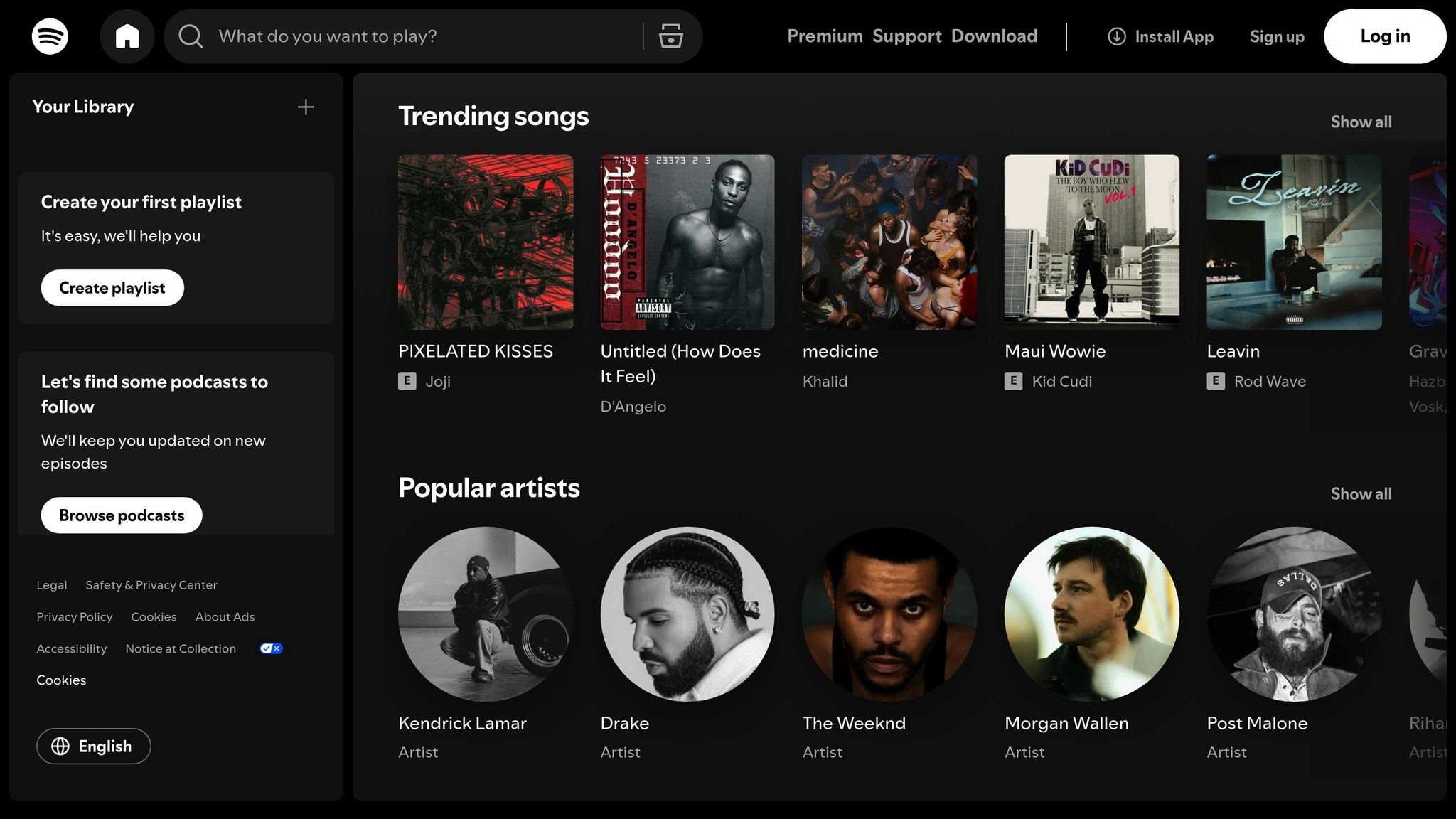
Spotify brings its music-first approach into podcasting, offering tools like personalized recommendations through features such as Discover Weekly and Release Radar. The platform seamlessly integrates podcasts with music playlists, letting users mix both into their daily listening habits. Premium subscribers enjoy perks like ad-free listening, unlimited skips, and offline downloads.
Apple Podcasts, on the other hand, focuses solely on podcasts, leveraging its integration across Apple’s ecosystem. Thanks to iCloud, the platform syncs listening progress, subscriptions, and downloads across Apple devices. For example, you can start a podcast on your iPhone during your commute and pick up right where you left off on your Mac.
Both platforms support offline listening, but their approaches differ. Spotify requires a Premium subscription for offline access, while Apple Podcasts allows free offline downloads for all users. This distinction can influence accessibility, especially for listeners who want to save data or listen in areas with poor connectivity.
Interface and Navigation
Spotify’s interface prioritizes discovery and engagement. Personalized podcast suggestions appear alongside music on the home screen, and the search function supports cross-content discovery, making it easy to find both podcasts and music. The "Recents" tab is a user-friendly addition, allowing quick access to previously played content – a thoughtful solution to a common frustration [3].
Apple Podcasts takes a simpler, more focused approach, designed specifically for podcast enthusiasts. The app organizes content into clear sections like Library, Listen Now, Browse, and Search, making it easy for users to manage subscriptions and track their progress.
Device Access
Device compatibility is a notable difference between the two platforms. Spotify boasts broad cross-platform availability, supporting all major operating systems [2]. It also works on various devices, from web browsers to smart gadgets, gaming consoles, and car systems. Integrations like Spotify Connect, Bluetooth, Apple AirPlay, and Chromecast expand its reach even further.
Spotify’s compatibility extends to smart speakers, gaming consoles like PlayStation and Xbox, and even vehicles, making it accessible almost anywhere.
"We regularly evaluate the operating systems and devices we support to deliver the best Spotify experience. As technology evolves quickly, we periodically update our support to focus on systems and devices with a significant active user base." – Spotify [2]
Apple Podcasts, meanwhile, benefits from being pre-installed on Apple devices like iPhones, iPads, Macs, and iPods [4]. This built-in accessibility ensures immediate availability for Apple’s large user base without requiring extra downloads or setup. For non-Apple users, the platform offers access via web browsers when logged in with an Apple ID, broadening its usability beyond Apple devices.
Audience Reach and Discovery
For podcasters, connecting with the right audience is everything. Both Spotify and Apple Podcasts bring distinct advantages to the table when it comes to reaching listeners and increasing your podcast’s visibility.
Audience Size and Engagement Data
Apple Podcasts hosts around 460,000 active podcasts, while Spotify boasts a staggering 6 million [1]. This difference in numbers creates unique opportunities for podcasters. On Apple Podcasts, the smaller catalog can make it easier for niche shows to shine. Spotify, with its massive library, offers access to a broader and more diverse listener base.
Spotify has also demonstrated the power of its discovery tools. In A/B tests, their exploration system increased audience numbers by 10× [7]. For new podcasters, this can be a game-changer, helping them grow their audience more quickly.
Discovery Methods
The way each platform helps listeners discover new podcasts is quite different. Spotify’s algorithm uses a mix of machine learning and collaborative filtering, analyzing user behavior – like plays, follows, and playlist additions – along with metadata to make personalized recommendations [5][6]. For instance, a study by Ausha revealed that 67% of podcasts in Spotify’s Top 100 include relevant keywords in their show titles. Using the right keywords can significantly improve a podcast’s ranking, while consistent uploads (preferably every 15 days) signal activity to the algorithm, further boosting visibility [6].
Apple Podcasts, on the other hand, leans heavily on listener behavior, particularly completion rates [5]. This approach often benefits niche podcasters, making it easier for them to connect with audiences who share specific interests [1].
User Demographics
Understanding the demographic makeup of each platform’s audience can shape both content and marketing strategies. Spotify gives creators detailed insights into their audience, including age, gender, location, and even music preferences [1]. Since Spotify is primarily a music streaming platform, podcasts often reach listeners during their regular music sessions, creating organic opportunities for discovery.
Apple Podcasts also provides valuable listener analytics, such as data on when users stop listening to episodes [1]. This information helps podcasters refine their content to keep listeners engaged and improve retention.
Both Spotify and Apple Podcasts reward engaging, high-quality content over sheer numbers. This levels the playing field for new and independent creators, allowing them to compete with well-established shows [6]. However, the journey to discovery depends on each platform’s unique algorithm and how users interact with it. Up next, we’ll explore how these audience dynamics influence monetization strategies.
Making Money from Podcasts
Monetizing your podcast starts with choosing the right platform. Both Spotify and Apple Podcasts offer opportunities for U.S.-based podcasters, but each comes with its own set of features, requirements, and processes.
Revenue Options and Requirements
Your choice of platform doesn’t just impact your audience reach – it also shapes your earning potential.
Spotify’s Multi-Tiered Approach
Spotify provides three ways to make money from your podcast:
- Subscriptions: This lets you offer exclusive, subscriber-only episodes. To qualify, you need at least two published episodes and 100 listeners on Spotify within the past 60 days[8][11].
- Spotify Partner Program: This ad-based revenue program has higher requirements – 12 published episodes, 10,000 global listening hours in the last 30 days, and 2,000 unique listeners during the same period[8][11].
- Spotify Open Access: This feature allows you to integrate external subscription platforms like Patreon directly into Spotify[8][11][12].
Both the Subscriptions and Partner Program require hosting your podcast on Spotify for Creators, and payments are handled through Stripe or Spotify’s own Payouts system[8][11].
Apple’s Subscription-Driven Model
Apple Podcasts takes a simpler route by focusing on subscriptions through the Apple Podcasters Program[9][10]. Unlike Spotify, Apple doesn’t require you to host your podcast on their platform. Instead, you need to join their program and complete a legal agreement. The setup involves providing your legal entity information, U.S. tax forms, and banking details to receive payments directly from Apple[9]. While Apple doesn’t specify minimum audience or episode requirements, your content must meet their guidelines and offer "ongoing value" to listeners[13].
Getting Started with Monetization
Entry Barriers and Earning Potential
Spotify’s Subscriptions program offers a low entry point, requiring just 100 listeners over 60 days. This makes it a great option for newer podcasters to start earning quickly. However, the Spotify Partner Program, with its higher thresholds (10,000 global listening hours and 2,000 unique listeners in 30 days), is better suited for established creators[8][11].
Apple Podcasts, by contrast, doesn’t impose audience minimums, which can be appealing for emerging podcasters. That said, Apple’s emphasis on "ongoing value" means you’ll need to consistently deliver high-quality episodes to succeed[13].
When it comes to earnings, Spotify’s Partner Program offers multiple revenue streams, including ads, but it’s harder to qualify for. Apple’s subscription model, on the other hand, provides a stable income through direct listener payments[9].
Setup Complexity
For Spotify, unlocking full monetization benefits might mean switching to Spotify for Creators, which could be a hurdle for creators already established on other platforms. Apple, meanwhile, focuses on completing legal and tax documentation, allowing you to keep hosting your podcast with your current provider[9].
Monetization Comparison Table
| Feature | Spotify | Apple Podcasts |
|---|---|---|
| Programs Available | Subscriptions, Partner Program, Open Access[8][11] | Apple Podcasters Program[9] |
| Minimum Episodes | 2 (Subscriptions), 12 (Partner Program)[8][11] | Not specified[13] |
| Audience Requirements | 100 listeners in 60 days (Subscriptions), 10,000 global listening hours and 2,000 unique listeners in 30 days (Partner Program)[8][11] | Not specified[13] |
| Hosting Requirement | Must use Spotify for Creators[8][11] | No specific requirement[9] |
| Payment Setup | Stripe or Spotify Payouts[8][11] | Direct payment via Apple (requires legal, tax, and banking info)[9] |
| Revenue Types | Subscriptions, ads, multiple revenue streams[8][11][12] | Subscriptions only[9][10] |
Your choice will depend on your audience size and long-term goals. Once you’ve made your selection, take advantage of the platform’s analytics and growth tools to maximize your podcast’s success.
sbb-itb-0e595bb
Analytics and Growth Tools
Podcast success involves much more than just tracking download numbers. Platforms like Spotify and Apple Podcasts offer unique analytics tools that can help you refine your strategy and connect with a broader audience.
Data and Reporting
Spotify: Discovery and Customization
Spotify for Creators focuses on helping podcasters understand how listeners discover their content. Through impression analytics, you can see whether your audience finds you via search, recommendations, or category browsing. This is crucial when competing with over 5 million audio podcasts and 100,000 video podcasts on Spotify [14]. Additionally, Spotify tracks completion rates, giving you insights to fine-tune your episode lengths for better engagement.
Apple: Engagement and Behavior Insights
Apple Podcasts Connect zeroes in on listener engagement, providing data on how audiences consume your content. With 29.2 million Americans using Apple Podcasts [1], the platform offers detailed metrics, such as listener locations and episode-specific performance. These insights help you understand what topics and formats resonate most, enabling you to adjust your approach strategically.
Together, these analytics tools provide a solid foundation for growing your podcast.
Promotion and Growth Features
Spotify’s Recommendation Power
Spotify’s recommendation engine can introduce your podcast to a massive audience of 42.4 million U.S. listeners [1], expanding your reach far beyond your existing fan base.
Apple’s Targeted Promotion
Apple Podcasts, with its smaller ecosystem of roughly 460,000 active podcasts compared to Spotify’s 6 million [1], allows for more focused engagement. The platform’s geographic and engagement data can shape your promotional efforts, ensuring they align with listener behavior.
Using Data for Content Planning
By leveraging analytics from both platforms, you can make informed decisions to improve your content and grow your audience.
Refining Episode Structure
Analytics can highlight where listeners tend to drop off during episodes. If your data shows early exits, you might consider tightening your introductions or improving transitions to hold attention [15].
Targeting Specific Audiences
Apple’s geographic insights are particularly helpful for U.S.-based podcasters. Use this data to tailor your content or marketing campaigns to specific regions [15].
Identifying Winning Topics
Episode-specific metrics can reveal which topics and formats perform best. Focusing on these high-performing areas ensures your content continues to resonate with your audience [15].
Adjusting Episode Length
Completion rate data from Spotify can guide you in determining the ideal episode length. For example, if shorter episodes have higher engagement, consider trimming longer ones to match listener preferences [15].
The most successful podcasters often combine Spotify’s discovery-oriented analytics with Apple’s detailed engagement data. This dual approach provides a comprehensive understanding of audience behaviors and preferences, helping you create content that truly connects.
Using Sounds Debatable Resources

Fine-tune your podcast strategy with insights from the Sounds Debatable newsletter. Titled "Podcasting’s Unanswered Questions – Dissected, Debated, Delivered" [16], this LinkedIn newsletter is packed with industry updates and actionable advice.
Curated by Cameron S., a seasoned expert in Podcast Strategy and Brand Positioning with experience collaborating on over 100 brands, the newsletter dives into platform updates and emerging trends. Subscribing gives you access to valuable insights that can help you sharpen your content and promotional approaches.
Leverage these expert perspectives to refine your podcasting game as you explore the detailed analytics and growth tools coming up.
Conclusion
Spotify and Apple Podcasts each bring distinct benefits to the table for US podcasters, and sticking to just one platform means missing out on a significant chunk of potential listeners. With 42.4 million Americans tuning in to podcasts on Spotify and 29.2 million on Apple Podcasts, distributing your show across both platforms is a smart move [1].
Spotify shines when it comes to monetization, offering creators a different fee structure and access to its 6 million hosted podcasts, which ensures a broad reach [1]. On the other hand, Apple Podcasts stands out with its algorithm that supports niche creators and provides detailed analytics, such as where listeners drop off. While its commission rates are higher, it still offers a straightforward monetization path for newer shows [1].
By distributing your podcast on both platforms, you can maximize your reach and avoid over-reliance on one audience or algorithm. The right strategy depends on your podcast’s goals. If audience growth is your priority, being present on both platforms is essential. For monetization, weigh each platform’s fee structure and subscriber base. And for discovery, combine Apple’s niche-friendly algorithm with Spotify’s social sharing features.
Considering the challenges podcasters face – like the high dropout rate after 10 episodes and ad earnings that often fall short of $500 per month for shows with under 5,000 downloads – a multi-platform strategy offers a way to reduce risks and expand opportunities [17]. Success comes from consistent effort and a diverse presence, not from betting everything on one platform.
Ultimately, the key to building a thriving podcast isn’t about choosing between Spotify and Apple Podcasts. It’s about leveraging both platforms to reach the widest possible audience and give your content the best chance to succeed.
FAQs
How do Spotify and Apple Podcasts compare in monetization options for new podcasters?
Spotify and Apple Podcasts each offer unique ways for podcasters to earn money, tailored to different strategies and goals.
Spotify opens the door to monetization through its Spotify Partner Program, which includes ad revenue, premium video earnings, and podcast subscriptions. To qualify, creators must meet specific requirements: they need to be based in the U.S., Canada, the U.K., or Australia, have published at least 12 episodes, and accumulated 10,000 streamed hours on Spotify within the last 30 days. Additionally, Spotify’s podcast subscriptions enable creators to provide exclusive content for a monthly fee, giving them another way to connect with and monetize their audience.
Apple Podcasts, on the other hand, leans heavily on subscriptions. Creators can offer exclusive content for a monthly fee, but there’s a catch – Apple takes up to 30% of the subscription revenue during the first year, dropping to 15% after that. This commission structure can influence earnings, especially for those with smaller audiences or slower subscription growth.
Both platforms offer solid monetization tools, but choosing the right one depends on your approach to content and how you plan to engage your listeners.
How do Spotify and Apple Podcasts help increase a podcast’s visibility and audience growth?
Spotify and Apple Podcasts each take a distinct approach to boosting podcast visibility and helping creators expand their audience.
Spotify leans heavily on user behavior to drive recommendations. It analyzes factors like listening habits, engagement levels, and playlist additions to suggest podcasts that align with individual tastes. Its centralized discovery system is particularly effective at giving new shows a quick boost by promoting them to the right listeners early on.
Apple Podcasts, on the other hand, emphasizes metrics such as completion rates and subscriber growth. Shows that keep listeners hooked and steadily grow their subscriber base are more likely to get featured. The platform also shines a spotlight on niche content, giving smaller podcasts a better shot at connecting with their ideal audience.
What are the benefits of distributing your podcast on both Spotify and Apple Podcasts?
Publishing your podcast on Spotify and Apple Podcasts can open the door to a much broader audience. Spotify, with its millions of active users, is especially favored by younger listeners. On the other hand, Apple Podcasts is accessible in over 170 countries and holds strong appeal among iOS users.
Using both platforms ensures your podcast reaches people with different listening habits and preferences. This approach not only makes your content more accessible but also boosts its visibility. Whether your focus is on growing your audience, monetizing your podcast, or building your brand, being on both Spotify and Apple Podcasts can help you get there.